Information inertia had me reading “The ABCs of Afghanistan” by Srdja Trifkovic and mulling over the posts which have started to collect on my desktop toolbar – shoving any functional tabs aside with their persistent and silent reminders that I really should write more rather than consume more and more infuriating news.
F is for Fighting.
That’s where the inspiration sparked this post – a photo essay of a little over 1,000 words…
F is indeed for fighting – something the Afghans of more generations I can conjure at the moment have done. Did the fighting start in ’79, or has it been simmering much longer than most people understand? The latter, of course – it isn’t accurately referred to as “the graveyard of empires” for nothing, after all.
However, my warning back in that first post 9/11 week resurfaces:
All of these countermeasures – the sandbag fighting positions at the post gates, the vehicle inspection mirrors, the increased vigilance – all of these things will gradually subside because we cannot keep it up indefinitely. We will get lazy… and this will happen again. Maybe not next year or in the next five years – we’re too tightly wound for that… but we will forget what happened a few days ago and find it all happening again.
Yes, I remember saying this, or something along this idea, several times as a response to my growing exasperation with the impulsive reactions I was watching throughout that September. Even at 27, I remembered the reaction from only a few years before when American embassies were bombed in Kenya and Tanzania: a façade of “force protection” and then business as usual.
There is one truth which resonated then as it does today:
They waited.
They were always waiting.
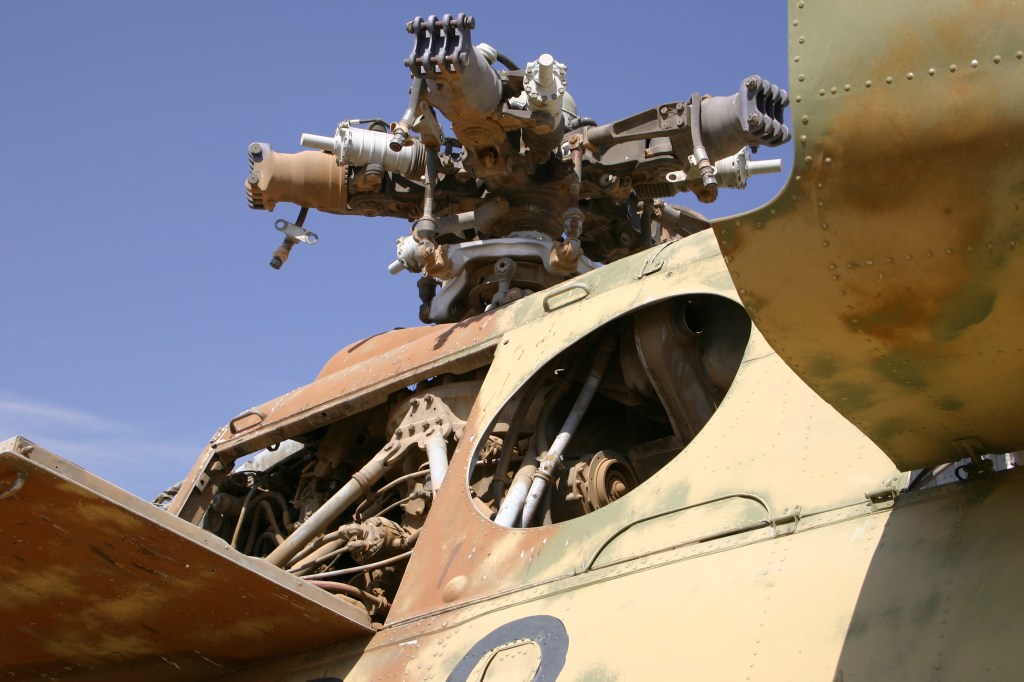
Perhaps many of that generation waited for the sound of Russian turbofans to die down in their youth – only to have the scream of unguided rockets end in the screams of the wounded as clans fought against clans, identities against identities, ideologies against ideologies.
Interesting that some of those same airframes from the ‘80s probably continued logistics support to the same bases, a little more than a decade or so later…

Some – as with the vendor looking at the camera – waited in Peshawar, Pakistan, until it was safe to return to the same land that had been in his family for generations. Maybe they waited to tell their tale or fabricate a believable alibi. Maybe the wait was more of a simmering in a stew of displaced resentment and frustration, where vengeance and new feuds are incubated…
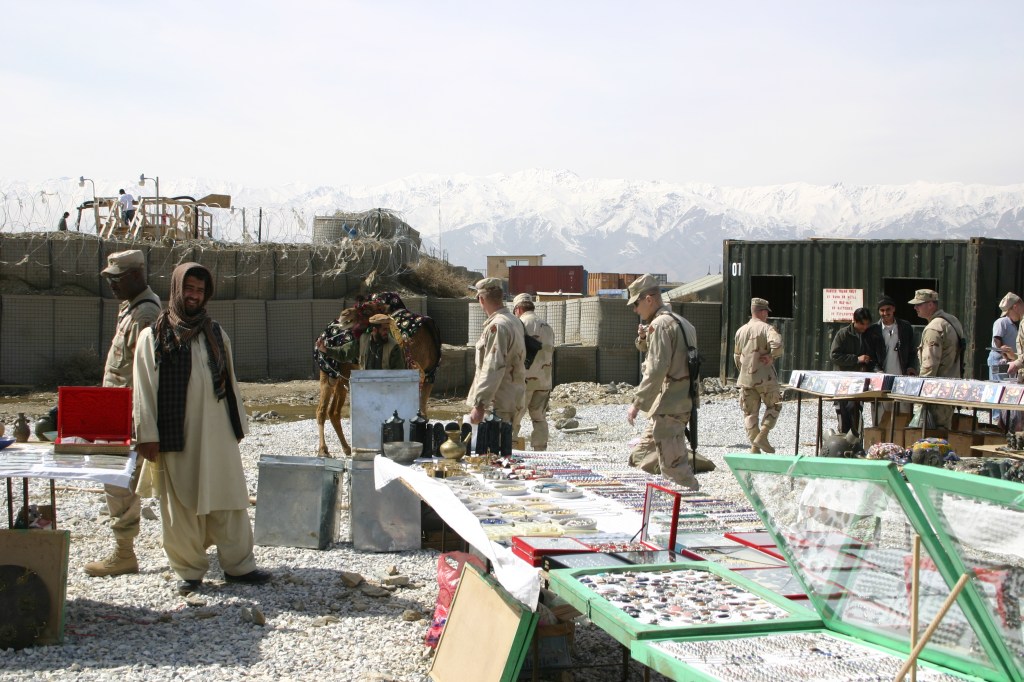
Quite possibly, the wait was one which was also quite profitable for those with access to either authentic or Khyber Pass-close replicas of vintage British firearms… which should have been more ominous foreshadowing of how successful things will more than likely turn out for us…
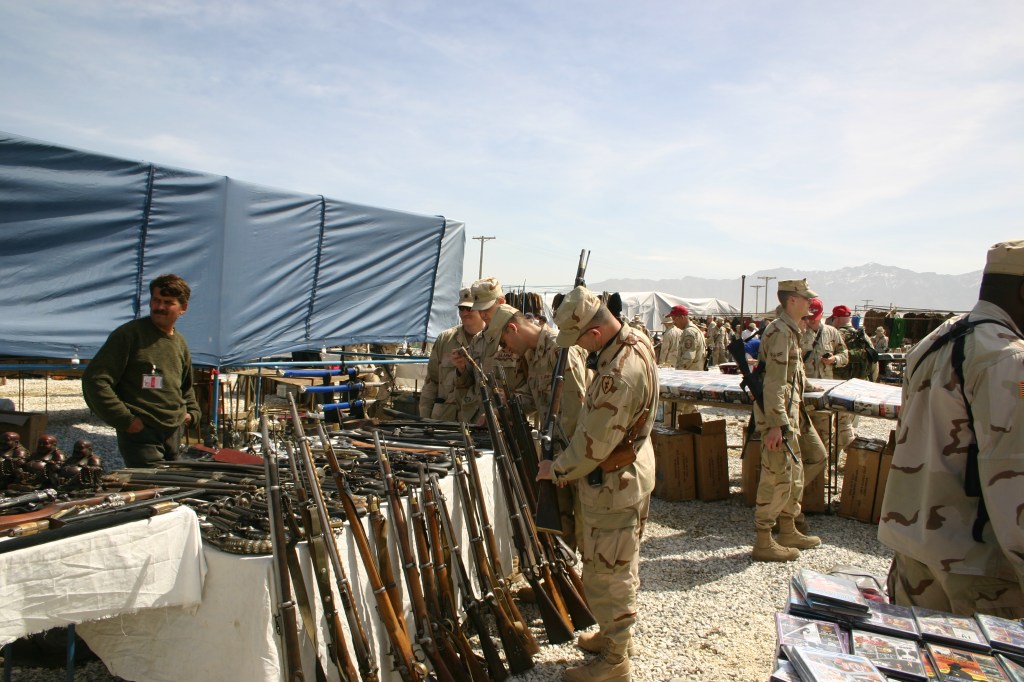
Or, the wait was for someone else with the cultural background which favored technology-based innovation and ability to fix the spoils of the previous conflict… Which is again should have ominous foreshadowing…
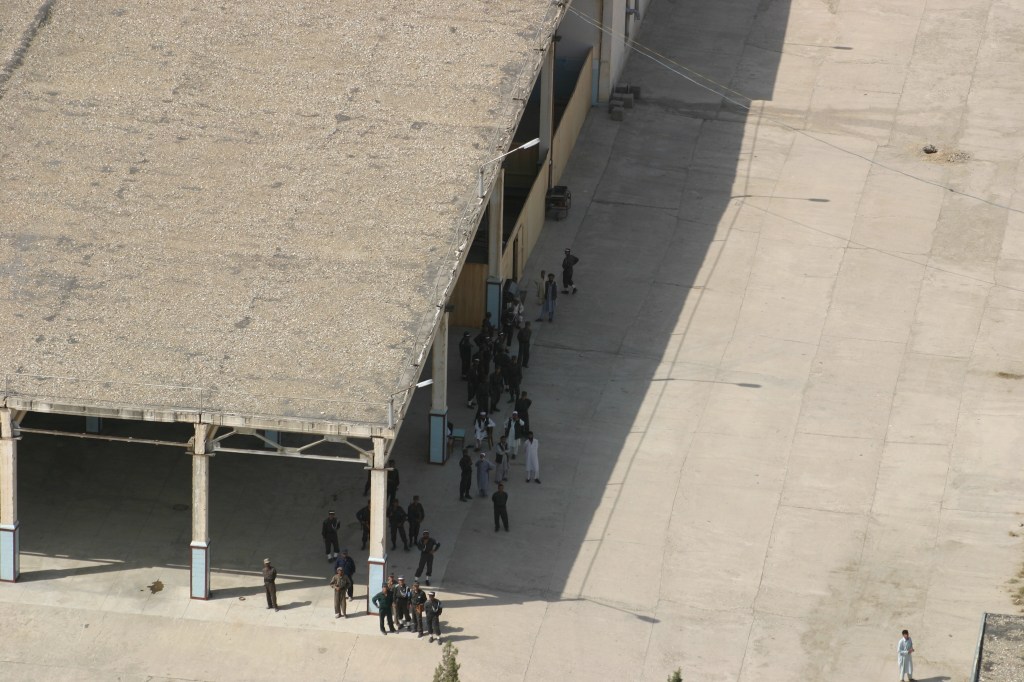
The wait could have been for the epiphany of how Western-styled democracy works and the sudden national pride in making it work with a distinct Afghan-flavoring. The lines in this picture, while short, were precursors for the 2004 election; the guards – and discarded lines of tanks, artillery, and other military vehicles unseen but to the right of this building – suggested that there might have been a slight chance that diplomatic and political efforts were working…
There was also the patience involved in an outside chance that the local industries, and – accordingly – the national economy would somehow manage to rebuild from the literal and figurative rubble to capitalize upon the untapped (for sufficient reasons) natural resources worth trillions…with a “T.”

These two… I remember them as being very engaging… and almost waiting for the invitation to be taken seriously as military peers. From the folks at Asadabad, we heard that they were effective and “damn-near fanatical” in using their old T-55 to lob 100mm shells at the surrounding ridgelines at suspected artillery spotter positions.
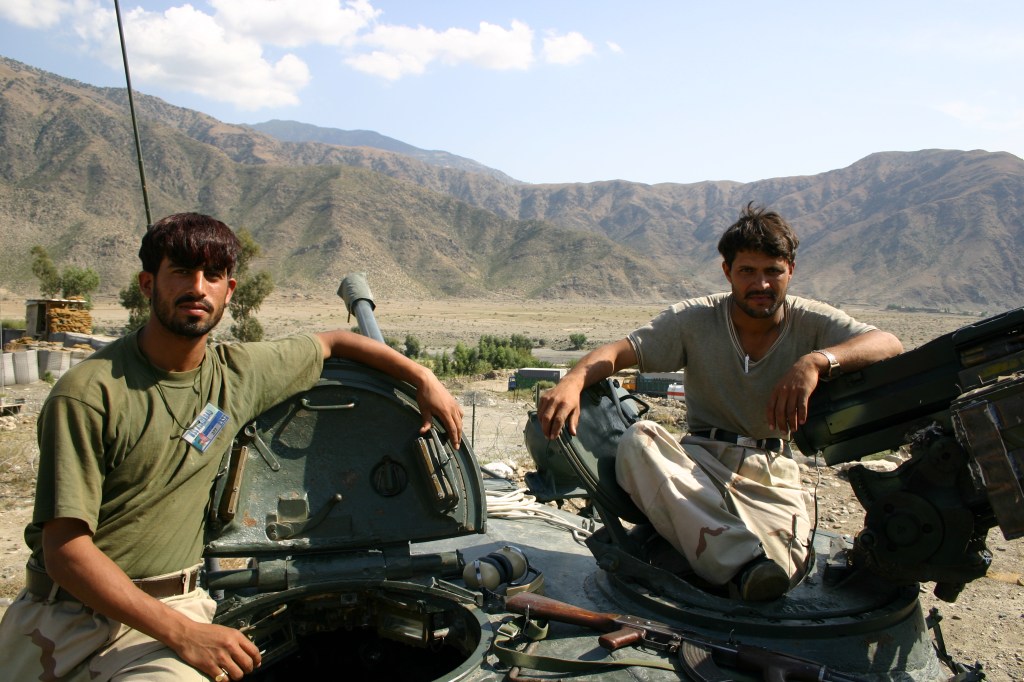
Civilians and military alike waited for us to do something. Make the fighting stop, show off our neat technology, fly, go away, or stay forever… Who knew?
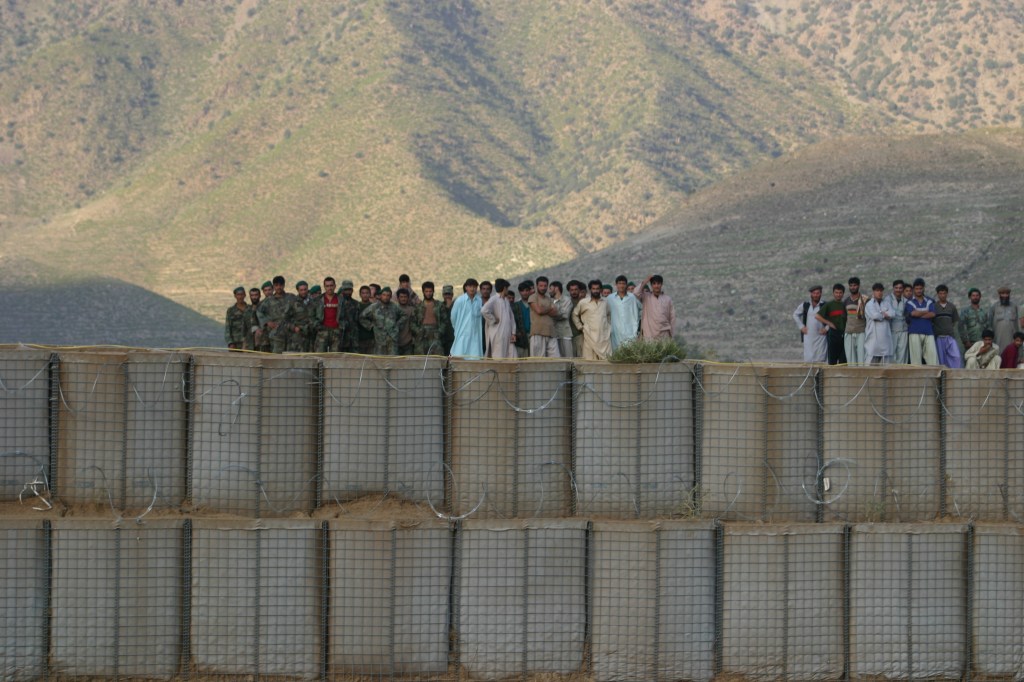
However, they were as good at waiting as they were watching. “Green on blue” events were fairly far back in our minds in 2004-05; however, we never got the feeling that our trust should ever be absolute and that alliances come and go faster a kite through a rotor system… and with a similar level of violence, as well.
This is the photograph which brought a mental shiver, hours ago – that we were being patiently waited out… that we were under constant observation to understand patterns, motives, reactions, and capabilities. If you think that it suddenly dawned on me after all these years, that would be a very incorrect assumption: any change in the patterns of the civilians or Afghan military/police forces immediately got my attention, and I had become a bit of an annoyance to our S2 folks with questions about surface-to-air equipment they never knew the Soviets left behind.

Finally, the next generation waited. Maybe they waited to be like us… maybe they waited for their turn to try to oust us. Given that Bamiyan was predominately Hazara and, therefore, more friendly than the other ethnic groups, I would be comfortable with the former – that they awaited their turn and opportunity to be independent. Perhaps the girls waited for the threat of the burqa to finally be cast aside; or, quite more realistically, they waited for when they had to follow in the footsteps of the women before them.
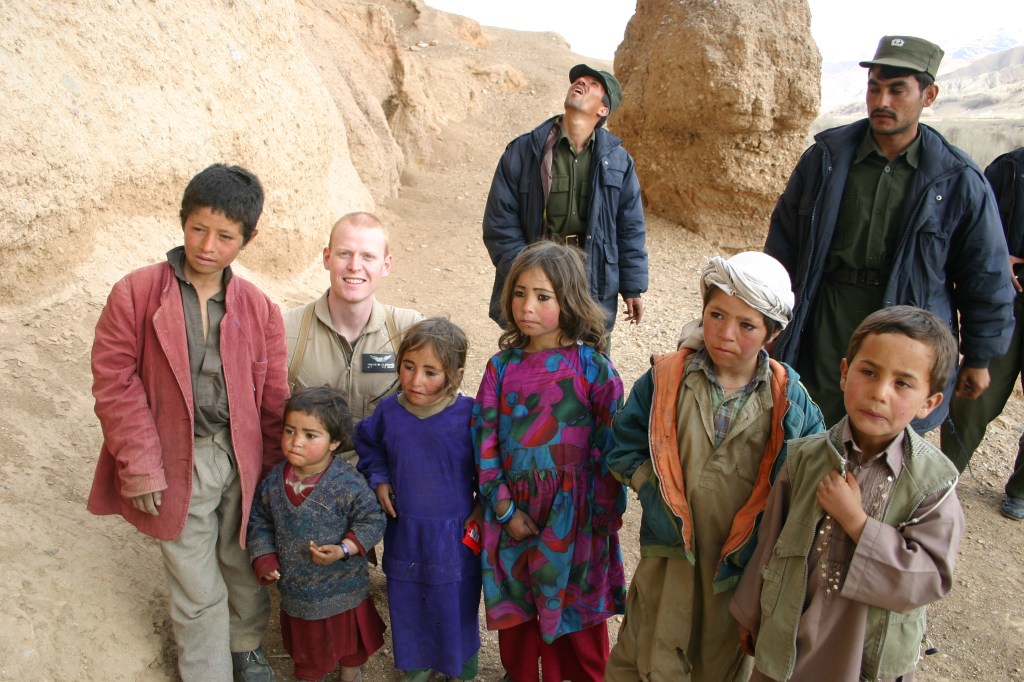
What happens when waiting becomes futile?
What happens when time runs out and the inaction of “holding on for just a little longer” becomes the realization that the right moment or event passed by without fanfare?
What happens when that waiting is in another refugee camp which becomes a political hot-potato no one can grasp for too long without getting burned by those on either or both sides of the fencing?
Pay attention to where these displaced refugees go as much as what happens in Afghanistan. To forget something of this magnitude leads only to the rhythm of history becoming more persistent.
[Edit]
From the comments:
“It would be fascinating to find out what Jim Gant think about all of this stuff in Afghanistan.”
I guess he was busy:
With the Taliban growing more violent and adding checkpoints near Kabul’s airport, an all-volunteer group of American veterans of the Afghan war launched a final daring mission on Wednesday night dubbed the “Pineapple Express” to shepherd hundreds of at-risk Afghan elite forces and their families to safety, members of the group told ABC News.
…The Afghan passengers represented the span of the two-decade war there, and participants included Army Maj. Jim Gant, a retired Green Beret…
Discover more from milsurpwriter
Subscribe to get the latest posts sent to your email.
 milsurpwriter
I knew when I was in Iraq in 06 that we were going to lose at the nation building game. The media liked to point out last year that there were US troops fighting in Afghanistan that were born after 9/11. What they should have been talking about were the Afghan kids that were the same age, but born into families that could clearly trace their heritage back 4 or 5 generations in fighting world powers from a fire power and technologically deficient position. When grandpas are teaching the grand kids how to shoot an RPG instead of a shotgun, that’s probably not a neighborhood you want to get mixed up in for too long. While US kids are learning the latest video games, those kids were learning the latest IED designs. While the rest of the world watches us debate about masks and other first world problems they take another drink of cloudy water and laugh.
LikeLiked by 1 person
We’re on the same page… Probably have been for quite some time – though we weren’t aware of the fact.
That’s what I find interesting about this whole thing: that so many vets echo the same ideas, and are reaching the same conclusions; because we’ve been on the ground, that fact is inevitable and obvious to only those who have been there. Of course, there are some exceptions for policymakers; for the most part those are exceptions to the rule.
So, we keep writing our observations and hoping for the best and preparing for the worst… Hopefully, the concept of “Badlands” will remain a geographical description rather than a socioeconomic one that we might be headed towards.
LikeLiked by 2 people
It really is astonishing how much the experience of the guys on the ground gets ignored, I still deal with this phenomenon today in my corporate job. I think even Lt. Col. Hackworth would be surprised at just how correct he was about why we will always be doomed to end these types of wars in this manner. I think the current administration could have done a better job pulling out and should be responding differently now, but I think the fact remains that the “Taliban” (or should I say those anti-American interests in the region) would end up in charge of the region again. As far as “Badlands” staying a geographical term, I guess only time will tell. Take care!
LikeLiked by 2 people
It really isn’t all that surprising that the operational facets of an organization are often overlooked. While it could be suggested that they do not share the same “big picture” understanding of the immediate tactics and long-term strategy (after all, would you want a 7-year SPC dictating the implementation of diplomatic policy?), the idea of “confirmation bias” and those who reinforce the confirmations of biases for personal/professional motivations is the biggest threat to any organization.
It would be fascinating to find out what Jim Gant think about all of this stuff in Afghanistan. While I avoid promoting folks to the altar of the cult of personality (yeah, that song is stuck in my head now), I found his approach on the ground to be more… grounded… in reality than other military leaders of the time.
Oh, I shall continue to abide and watch/read/think – understanding which direction and how hard the winds might blow will give me an idea of how best to teach my kids how and when to tack.
LikeLiked by 2 people
Very true. I think the whole problem with this war and others have been those same biases and personal/professional motivations. I find it interesting that now that GWOT 1 is essentially over with we are suddenly focusing on the threat of China, as if it just appeared in the last month. While I definitely agree that China is a threat, they’ve stated it themselves, we once again are already gearing up the Military industrial complex to counter these new threats in the same manner we tried to fight the GWOT – Big budget tech. All the while ignoring the complete saturation and penetration of our society by communist Chinese influence. I’m not really sure why we are worrying about the South China Sea (other than microchips) when the radical groups in our country, including the media, have such obvious direct ties to this same threat. Plus, with so much western investment in China, would there ever be a kinetic war where western governments would bomb their own investments? Seems strange to me..
LikeLiked by 2 people
“Plus, with so much western investment in China, would there ever be a kinetic war where western governments would bomb their own investments?”
Why wage a kinetic war when an ideological decay from within would be much more effective and cheaper?
Doctrine, and “it worked in Iraq/Afghanistan” will be problematic beyond whatever words I will type here. Along with this, it quite clear no one ever watched BSG to have an idea how effective using ones own technology against their enemy actually can be…
LikeLiked by 2 people