Sitting upon my bookshelf – in a spot jokingly designated as my “grab in case of fire” section – sits a thick book with a black spine and a card catalog sticker on the gradually tattering plastic dust cover. Joseph Gores’ Marine Salvage – The Unforgiving Business of No Cure, No Pay once belonged to my Junior High School, and after a year of consistently checking it out, I ended up “losing” it by the end of the school year. To this day, I cannot remember what I paid for it, but it has turned out to be one of my most cherished investments since 1988.
Within the pages were stories which were seeds in my fertile mind. Stories of wrecked ships which most histories have forgotten and the men who were determined to buck all sane odds to do the impossible, often with sparse resources, incomplete pictures of the situation beneath the water, and the natural foes of the elements against them. For some people, they can place the beginnings of an interest in a topic or activity in one place – in my case, it was the stories of men like Edward Ellsberg, John Iron, Joseph Karneke that served as the template for what defined dedication… but it was the events which started a century ago on this day – and Ernest Cox’s later exploits in raising a good portion of a the scuttled German High Seas Fleet from Scapa Flow – which cemented my interest in not just history, but of the motivations and machinations of the men who were central to those stories.
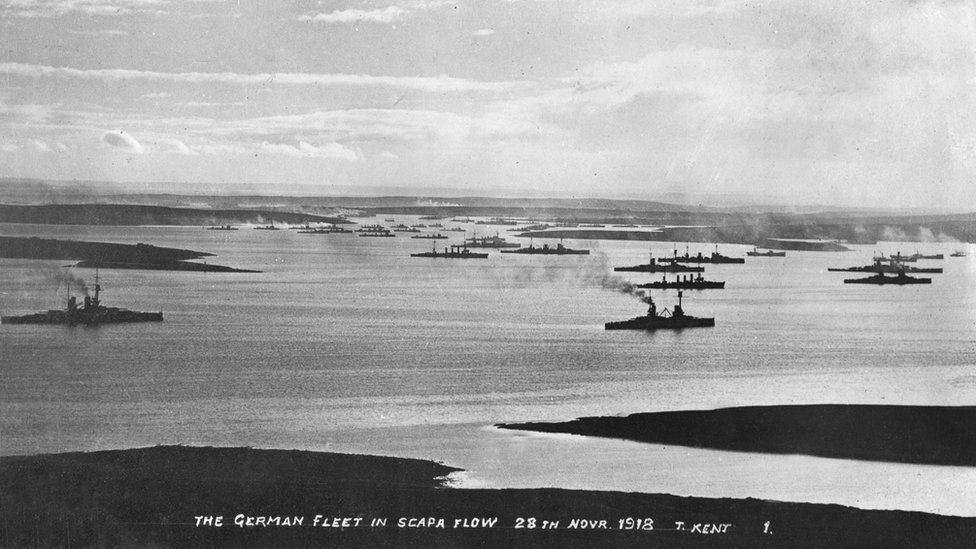
Not too long after 10am on June 21st, 1919, German Admiral Ludwig von Reuter gave the command from the SMS Emden to hoist the signal flags “DG,” preparing his command for an action which was considered to be the only recourse for a once proud fleet interned and neglected at Scapa Flow. The scuttling of the German warships had been a consideration since their surrender and subsequent arrival in the Scottish harbor shortly after the Armistice was signed on November 11th, 1918. The spreading contagion of Communism within the fleet, combined with the demoralization of losing the costly war, poor communications to and from Germany, and the desire to hold onto whatever vestiges of pride helped foster the notion of denying the British, French, Italian, and American forces any ease of assuming control of the German warships. Wallace Lewis’ 1969 dissertation The Survival of the German Navy 1917-1920: Officers, Sailors, and Politics gives a sufficiently brief summary:
One can thus understand how von Reuter came to his decision. To him and to the other naval officers, surrender to the enemy in any form was weakness. If the German government could not be depended on to protect the navy’s honor, it was up to the officers.
Von Reuter had taken three days in direct planning and the distribution of his orders, using the small boats the British had placed at his disposal for communications and logistics support for the German fleet. As part of his daily communiqués on June 17th, von Reuter had included one very specific paragraph:
It is my intention to sink the ships only if the enemy attempts to seize them without the consent of our Government. Should our Government agree with the peace conditions, in which the ships are to be surrendered, the ships will then be handed over, to the lasting shame of those who put us into this position.
The terms of the Armistice were to expire on June 21st; von Reuter, due to the indifferent British Admiralty’s decision not to inform him that an extension had been granted to June 23rd, was unaware of this on the morning of the 21st and under the assumption that hostilities were inevitable. Thus, von Reuter followed his preparatory flag and light signal with another one which, once acted upon, would be irreversible:
“Paragraph Elf. Bestätigen.” (“Paragraph Eleven. Confirm.”)
The crews of every ship in his command immediately went to work below – if a hatch, vent, or tube could be opened, it was; additionally, everything which could operate a valve or hatch was destroyed before being cast overboard. Water poured into each of his 74 ships at varying rates, with the SMS Friedrich der Grosse sinking first at 12:16 pm and the SMS Hindenburg going under at 5:00 pm.
British reaction was initially confused due to the suddenness of the coordinated scuttling. The extension of the Armistice had afforded time for torpedo practice for the attending British warships; the departure of most of the fleet on the morning of the 21st was noted as well as fortuitous for the Germans. Before the end of the day, the British had managed to save only 22 ships of the original 74 by towing them to the nearest shore and beaching them in the shallowest water possible. The chaos also proved to be the setting for the final, and unfortunate, deaths of the First World War when German sailors were shot and killed as they headed towards shore in lifeboats.
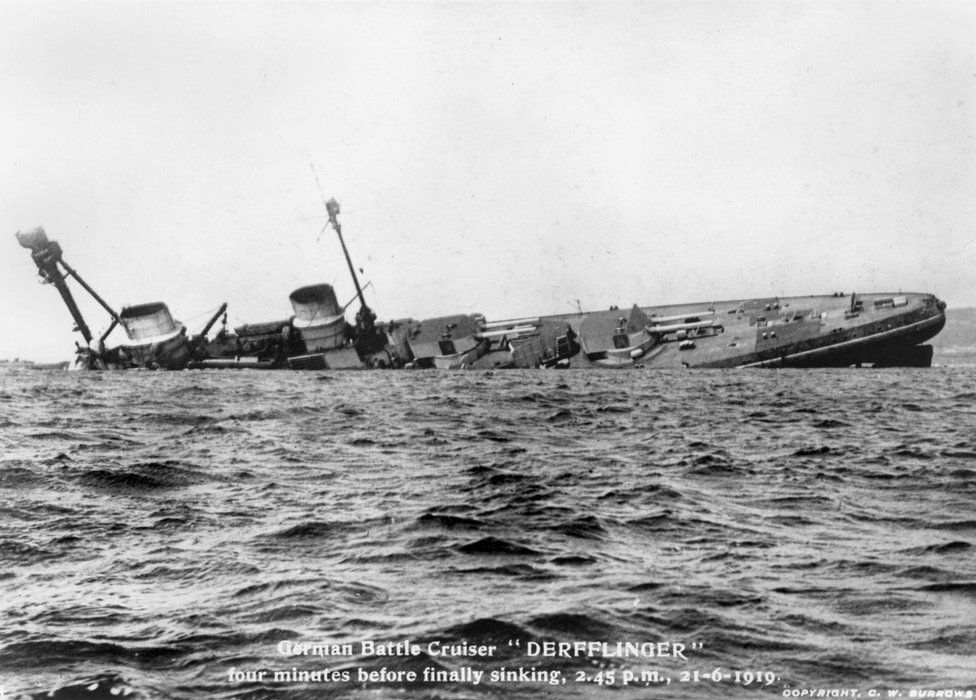
Von Reuter returned to Germany a hero in January 1920 as a hero after a brief period of imprisonment for his actions and dedicated salvage operations on his former fleet began in 1922. By the 1970s, all but 7 had been successfully raised for the scrap metal markets which have fluctuated over the years; these remaining warships continue to provide a financial value to the Orkney Islands as a destination for the hardiest of SCUBA divers.
“Paragraph Eleven. Confirm” continues to stand as a brief hook for those interested in a variety of topics: naval history, leadership, salvage, warfare, and the tumultuous political environment which Germany had descended into during the years between the two World Wars.
What we presently stand to glean from the events of a century ago is up to the individual and their own biases; for me, it has given me an appreciation for the smaller parts of a much larger story, a destination for future travels, a taste for a great single-malt Scotch, and the continued motivation to write about my own views on all of the above topics.
…After all, 100 years really isn’t that long in our often cyclic history.
Discover more from milsurpwriter
Subscribe to get the latest posts sent to your email.
 milsurpwriter
Reblogged this on Dave Loves History and commented:
Mike’s article about the scuttling of the German Imperial fleet this day in 1919!
LikeLiked by 1 person