Posted 7Sep18.
“Can a submarine shoot down an aircraft?”
During the Second World War, they had to. It didn’t matter if the submarine was sailing under an Allied or Axis flag – aircraft, for those diesel boats, were the harbingers of destruction.
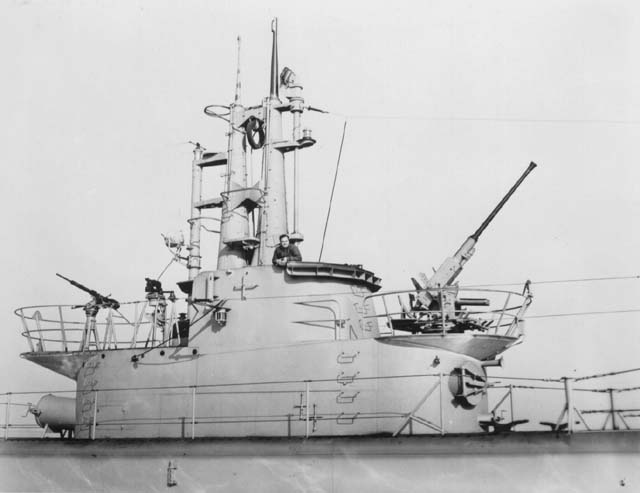
One handy example of many:
On 21 April 1943, while operating off the Malay Peninsula during her sixth war patrol, Grenadier sustained heavy damage to the after portion of the ship as the result of a Japanese aircraft depth bomb attack. The most serious casualty which occurred, and which directly caused Grenadier’s loss, was the complete immobilization of her propulsion plant due to derangement of the main control cubicle and severe misalignment of the propeller shafting. All efforts by ship’s force to effect emergency repairs were unsuccessful. Early the next morning, Grenadier was abandoned and scuttled by her own crew to prevent imminent capture by an approaching Japanese merchant ship.
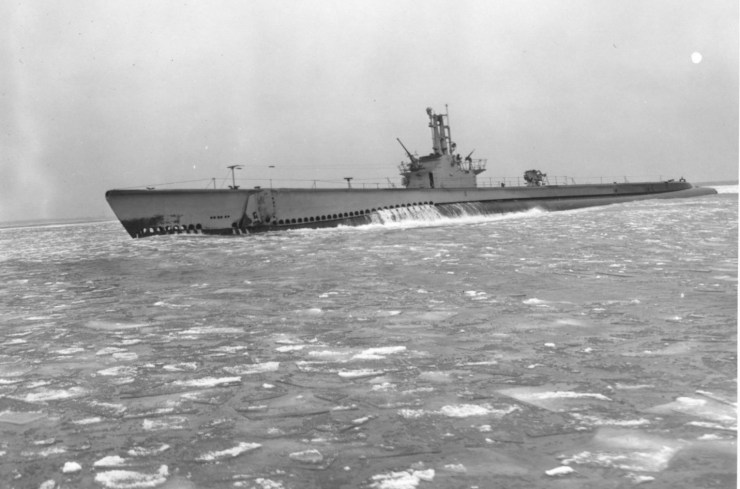
Diesel boats of the Second World War (and even today, discounting the Air Independent Propulsion systems currently gaining favor in some navies), needed to surface to recharge their batteries. Of course, the development of snorkels during the war negated this requirement by allowing for the engines to be run (and battery charges to take place) while the submarine remains safely below the water; prior to this development, the submarine’s vulnerability on the surface dictated the installation of various anti-aircraft weaponry.
The problem with anything mounted on the decks is that they increase both drag and flow noise while the submarine is underwater. Following the Second World War, the Greater Underwater Propulsion Power Program (GUPPY) borrowed heavily from the pair of captured German Type XXI U-boats to streamline the existing American Gato (only two of 77 produced), Balao, and Tench-class submarines for post-war use.
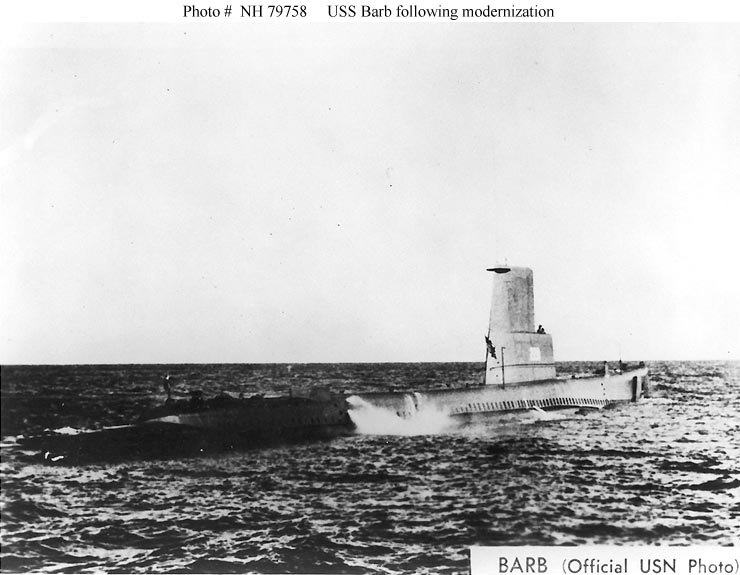
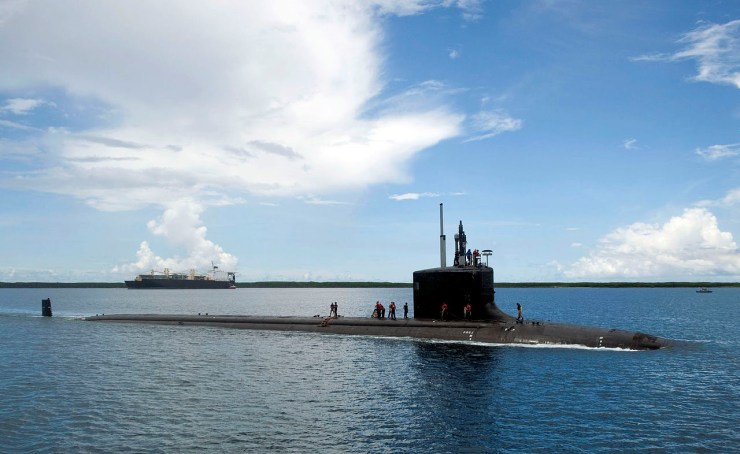
With the commissioning of the USS Nautilus in 1954, the U.S. Navy had moved beyond diesel propulsion and into the nuclear age of submarines. Stealth became the primary defensive tactic against anti-submarine warfare (ASW) aircraft, therefore little consideration of anti-aircraft weaponry was given as the Nautilus started submarine design along the path which has led us to the current Virginia-class fast attack submarines.
“Mike, this still doesn’t answer the question of whether or not a submarine can shoot down an aircraft.”
Today?
No… well, sorta. Man-portable air-defense systems (MANPADS) like the Stinger, Igla, or QW-18 could be theoretically carried within all modern submarines, and there has even been talk (and Soviet research, during the Cold War) of mast-mounted systems for both the Blowpipe and Mistral systems, but there is never an easy solution to complex problems.
With everything I have written on this answer so far, let’s look at the tactical need for such an event to happen. First and foremost, the submarine would have to be at or near the surface for such a system to acquire and engage a threat aircraft. By that time, it may already be far too late for the submarine, as the threat has more than likely identified and tracked the sub with prosecution occurring very shortly thereafter. Also, with the launching of any missile from at or below the surface, the submarine’s location would be verified to any and all ships or aircraft within visual range. Both of these points illustrate the fact that by the time such a weapon would be needed, the element of surprise offered by whatever expensive stealth features designed into the submarine would be quickly lost.
Would it make sense to equip modern submarines with the capability to directly protect themselves against ASW aircraft and helicopters? No – they are already designed with enough features and commanded by skippers well-versed in avoiding situations where they would be needed in the first place. As much as I love the “classic” lines of the American submarines of the Second World War, their lethal beauty of long ago is a testament to a much different form of warfare.
Discover more from milsurpwriter
Subscribe to get the latest posts sent to your email.
 milsurpwriter
Reblogged this on Dave Loves History.
LikeLiked by 1 person
Yeah… let’s just stay deep and let the flyboys wonder where we are…
LikeLiked by 1 person