History is often regarded as the victorious tales of a nation’s forces against a ruthless enemy. There are times, however, when a defeat is overlooked as a point of inconvenience to the national narrative. The utter lack of attention given to the geopolitical situation leading up to the beginning of the Korean War in 1950, overconfidence in the intelligence assessments confirming the U.S. biases, and military lack of preparation for another conflict so close on the heels of the Second World War offers a reminder of the hazards of selective attention to the favorable stories rather than the precautionary tales best heeded.
The initial stages of any conflict are often beset with tactical and operational confusion for the defending forces as they struggle to contend with the realities and immediate reaction to hostile aggression. For the American forces pledged with providing assistance and maintaining the sovereignty of South Korea against the threat posed by the northern Democratic People’s Republic of Korea (DPRK), the start of hostilities began on June 25, 1950. With the initial early-morning invasion of South Korea by the North, the chaos which followed for the next few months reflected a level of political and military apathy which failed to correlate the ability and intentions of the North Korean army. Consequently, one of the most important lessons of the Korean War can be found in a study of one such battle – the Battle of Chochi’won – which took place between July 10-12, 1950 and stands as an example of despite the lack of sufficient situational awareness and the presence of overwhelming odds.
Following the end of the Second World War, several factors contributed to create the political and military conditions which preceded the Korean War. Initially closed to earlier contact with Western civilizations, Korea reluctantly sought to establish diplomatic relations with the U.S. as early as 1905, but was relegated to communication through the Japanese embassy rather than formal recognition and relations as nation.[1] Immediately after the end of the Second World War, the Soviet occupation force established Kim Il Sung as the Communist leader of the northern provinces of Korea, while the American Army continued to allow Japanese authority to govern southern parts of the country.[2] With American military reductions after 1945 having greatly diminished the wartime strength of the military due to the lack of a formal and realistic foreign threat, the political and military conditions on the Korean Peninsula provided Kim Il Sung with the opportunity to stoke nationalistic and Soviet support for an invasion of South Korea with the goal of unification under Communist rule.[3] With much of North Korea’s army having gained valuable experience supporting Communist Chinese forces in their efforts to quell sedition and uprisings in Manchuria the late 1940s, and the possible assistance from pro-Communist guerilla forces in the southern mountains, the invasion and conquest of South Korea was deemed by Communist leadership to be a safe and quick victory.[4] For the ill-prepared armies of the Republic of Korea and U.S., the initial invasion and southward push of the North Korean forces forced the adoption of defensive and delaying measures until sufficient reinforcements could arrive.

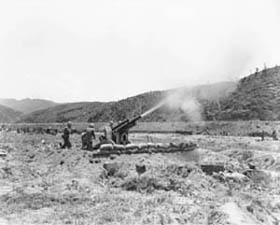
As one such effort to retard the North Korean advance, the American efforts around Chochi’won, stands out as an example of the disorganized yet determined actions performed by the U.S. Army as they retreated southward. With orders from Maj. Gen. William F. Dean to defend the roads leading to Taejon and the vital airfield and rail assets located there, roughly 2,000 men of the 21st and 34th Infantry Regiments were tasked to face the approaching 20,000 North Korean infantry and associated armor.[5] In a series of actions consisting of American units engaging the enemy forces only long enough for retreating units to establish new defensive positions, the additional support of the infantry consisted of heavy air strikes and limited armor and artillery support through July 10.[6] Though maintaining a communications and logistic line through Taejon and Chochi’won, the American forces at both locations began to sustain heavy losses as North Korean forces flanked the defenders on July 11.[7] A combination of North Korean military efficiency, destroyed communications hubs, and American air support negated by fog, the defenders became in isolated and desperate defensive actions as they slowly withdrew south with a loss of 409 men.[8] Though defeated by experienced North Korean forces enjoying numerical superiority, the American units at Chochi’won proved capable in offering a determined resistance and thus denying the North Koreans the easy victory they had assumed.
The early phases of the Korean War saw the successful use of North Korean momentum which was accentuated by the combat mass and experience of their forces. Politically, Kim relied on Communist ideology and the fomenting of anti-Western dissent to assist the military efforts to take South Korea. This outcome failed to manifest due to either the arrest of Communist sympathizers by the South Korean government or the voluntary emigration north prior to the beginning of the Korean War.[9] North Korea also inaccurately predicted the resiliency of the South and the American defenders. Though relatively isolated from the major logistic bases and hampered by the economic shift in priorities following the Second World War, many of the key American leaders possessed practical combat experience from as early as the First World War and understood the gravity of the tactical and strategic situation.[10] Finally, the advantages of American airpower in the action around Chochi’won, though dependent on favorable weather, proved to be an effective combat equalizer throughout the war.[11]
The early days of the Korean War was the result of excessive optimism by the North Koreans as well as their counterparts in the South and America. Yet, the combatants shared determination for their respective causes – domination and defense. However, the American and South Korean response to the initial confusion and ferocity of the North’s rapid advance beyond their border serves as an effective reminder of the potential all combatants are capable of when their survival – political and mortal – are threatened.
Notes:
[1] Bong K. Lee, Unfinished War – Korea, (New York: Algora Publishing, 2007), accessed February 22, 2017, ProQuest Ebook Central, 9.
[2] Ibid., 29.
[3] Mina Yoon, “Who do North Koreans think started the Korean War?,” nknews.org, 2014, accessed February 22, 2017, https://www.nknews.org/2014/01/who-do-north-koreans-think-started-the-korean-war/.
[4] Michael J. Seth, A History of Korea, (Blue Ridge Summit: Rowman & Littlefield Publishers, 2010), accessed February 22, 2017, ProQuest Ebook Central, 271.
[5] Roy F. Appleman, South to the Naktong, North to the Yalu, (Washington D.C.: Center of Military History, 1992), accessed February 22, 2017, http://www.history.army.mil/books/korea/20-2-1/toc.htm, 88.
[6] Ibid., 95.
[7] Ibid., 97.
[8] Ibid., 98.
[9] Michael J. Seth, A History of Korea, 273.
[10] James Stokesbury, A Short History of the Korean War, (New York, N.Y.: Quill, 1988), 45.
[11] Roy F. Appleman, South to the Naktong, North to the Yalu, 95.
Discover more from milsurpwriter
Subscribe to get the latest posts sent to your email.
 milsurpwriter
Reblogged this on Dave Loves History.
LikeLiked by 1 person