The first two parts of this series covered early assassinations as well as the impact of such events during the violent Civil Rights era. This post will look at the impact of foreign events to provide a counterpoint to the availability and repercussions of the use of firearms in targeting diplomats and influential figures.
What were the types of firearms responsible for major political and national conflict?
Who was the target and what made them vital to a cause or ideal?
Who was the “shooter” and what were their motivations?
Overall, what were the repercussions of these intersections between privately-owned firearms and policy – both foreign and domestic?
The initial idea of any good research project is rarely the same as the conclusion. Originally, this was going to be one post; as the process continued, the convoluted stories necessitated a change in approach. The cases of Mahatma (1869-1948) and Indira (1917-1984) Ghandi are related only though the violence which ended their lives.

Mahatma Gandhi was killed on January 30, 1948 by a Beretta M1934 semi-automatic pistol in .380 ACP caliber, purchased through a series of private transactions in New Delhi for 250 rupees. As one of the most famous advocates for peaceful protests, Mahatma Gandhi’s platform of non-violent civil disobedience not only paved the way for India’s realization of independence from Great Britain in 1947, but also served as a key source of inspiration for many civil rights leaders and activists following his death. His assassin, Nathuram Vinayak Godse (1910-1949), was a Hindu nationalist incensed at the manner in which patience for Muslim violence against Hindus and Sikhs Pakistan was advocated by Mahatma. During Godse’s trial, his own admission of his rage were firm: “…and when I found that even after such terrible results Gandhiji continued to pursue the same policy of appeasement, my blood boiled and I could not tolerate him any longer.” Around the globe, Mahatma’s death was mourned; within the region, riots were relatively limited in testimony to his legacy of pacifism.
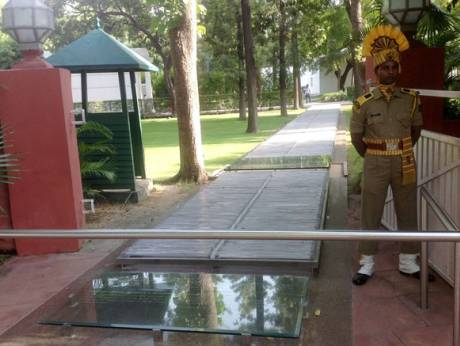
The betrayal of a political figures’ own security personnel stands out as an outlier in terms of the theme presented in this series. The guards responsible for the protection of Indira Gandhi – the 3rd Prime Minister of India – were equipped with the contemporary small arms available to the Indian military: 9mm Sten submachine guns and .38-caliber revolvers. Though not much information is available about the exact weapons used to cut down the Prime Minister, the identities of both assassins and their motives are well-documented. Beant Singh (1959-1984) and Sawant Singh (1962-1989), while unrelated to each other, shared a mutual disgust over Indira Gandhi’s handling of Sikh militants during Operation Blue Star in the early part of June 1984. The resulting turmoil which widened the rift between Hindu and Sikh carried on for three days and resulted in about 11,000 retaliatory Sikh deaths within the region; the lingering mistrust between these two sizeable populations in India echoes to this day.
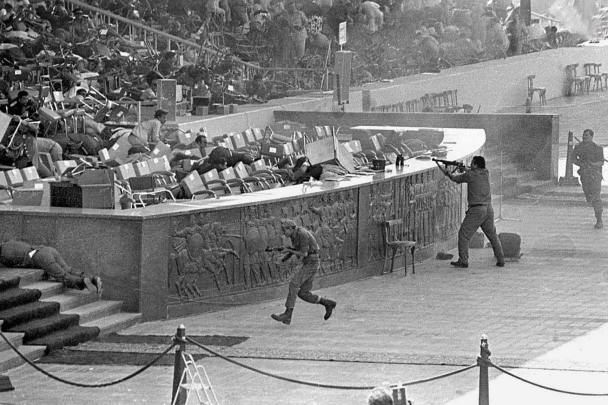
As the final example of the circumstances surrounding the assassination of key heads of state, the October 6, 1981 killing of Egypt’s President – Mohamed Anwar al-Sadat – serves as an example of the complex lengths his enemies went to in the planning and consummation of such an act. Much like the later assassination of Indira Gandhi, the weapons used to gun down Sadat and 8 other spectators during a military parade in Cairo were standard within the Egyptian armed forces: unspecified grenades and the ubiquitous 7.62x39mm AK-47. Likewise, the threat presented itself as benign. The crew of an artillery prime mover had stopped before the reviewing stand and disembarked in a manner which appeared to the officials and security personnel as part of the parade. With one individual designated solely to target Sadat with grenades and gunfire, the three others provided suppressive fire to keep security elements off-balance. Sadat had been the first Arab leader to officially recognize Israel in 1977, and his assassination was the pinnacle of Arab resentment at the negotiations with an enemy which had defied their actions since 1948. 30 years afterwards, during the first interview with American media, the leader of Al Gamaa al-Islamiyya, Aboud El Zomor, summarized his role in plotting the assassination: “… to change and provide an alternative leader who could save Egypt from a crisis of the political dead-end we lived in then.”
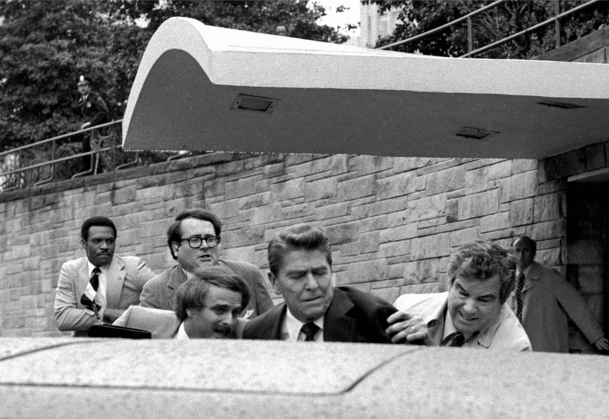
Not all assassination attempts were successful, and two of these attempts also occurred in 1981. The first was the attempt on President Ronald Reagan (1911-2004) on March 30. The Röhm RG-14 was a simple and small revolver chambered in .22LR, and was purchased for $47.95 by John Hinckley (1955-) at a Dallas pawn shop. Hinckley was an emotionally disturbed college dropout, was sufficiently enamored with actress Jodie Foster to commit an act which he felt would earn her reciprocated affection. Legislation in the form of the “Brady Handgun Violence Prevention Act” became law in 1993 and provided for mandatory federal background checks during the purchase of firearms as well as establishing a 5-day waiting period for such purchases.

44 days later, another attempted assassination occurred in Rome, on May 13. The target, Pope John Paul II (1920-2005), was shot four times with a 9mm Browning Hi-Power semi-automatic pistol fired by Mehmet Ali Ağca (1958-), a Turkish smuggler who had escaped from prison in 1979. Ağca’s motives for targeting the Pope were never ascertained with any semblance of certainty other than a note protesting the Soviet Unions’ actions in Afghanistan and the U.S.involvement in El Salvador; indeed, Ağca has repeatedly made erratic declarations during his three decades’ imprisonment for the attempt on the Pope and subsequent murder of a Turkish reporter. Though no local or global turmoil followed the attempt, the Pope bestowed forgiveness upon his would-be assassin during a visit to his cell in 1983 and advocated Ağca’s pardon in 2000.
Up next: thoughts and conclusions…
Discover more from milsurpwriter
Subscribe to get the latest posts sent to your email.
 milsurpwriter
1 thought on “Inconsequential Consequences (Part 3 of 4)”