Effective training rarely needs high-end technology and impressive graphics to truly be effective. In some cases, the basic ingredients require a checklist, a dry-erase board, an engaged audience, and a demented imagination.
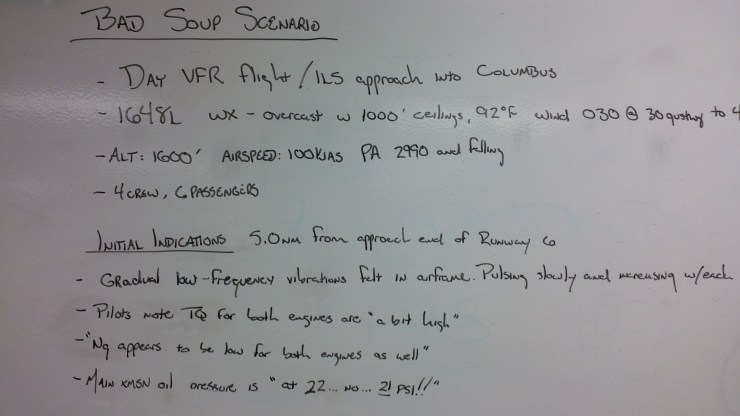
“Bad Soup Scenario”
- Day VFR flight / ILS approach into Columbus
- 1648L, WX – overcast w/ 1000’ ceilings, 92̊ F, wind 030@30 gusting to 40
- ALT: 1600’ AIRSPEED: 100 KIAS, PA: 2990 and falling
- 4 Crew, 6 Passengers
Initial Indications
- 5 NM from approach end of Runway 6
- Gradual low-frequency vibrations felt in airframe. Pulsing slowly and increasing
- Pilots note TQ for both engines are “a bit high”
- “NG appears to be low for both engines as well…”
- Main XMSN oil pressure is “at 22… no… 21 PSI!!”
The spirit of this thought problem was twofold: to draw the enlisted crewmembers into a situation where time was not on their side due to the evolving problem and the environmental considerations. In this case, the failure of the main transmission, according to the checklist, would necessitate the primary activity of “land as soon as possible” with the auxiliary power unit (APU) to be started – time permitting – providing electrical power once the both main generators were pulled off in an effort to reduce the load on the transmission.
All of these steps were simple, once the proper failure was identified by the crew. However, the location where these faults manifested was intended to rapidly funnel any misdiagnosis or delays into a very constrained resolution where the landing options went from “bad” to “catastrophic.” From the large parking lots of Phenix City, Alabama to the densely-populated urban sprawl of Columbus, Georgia, “land as soon as possible” and the nature of the emergency determined what type of landing was going to be required as well as the collateral damages possible when time and functionality of the transmission expired.
Open ended questions along the lines of “do you continue to Columbus?” were intentionally posed to offer a comfortable alternative to being in the news as “the Army Blackhawk crew that landed in front of the 14th Street Piggly Wiggly,” but the choice to press on would have inevitably lead to another hypothetical and considerably morbid headline. Interestingly, the former was the most popular choice amongst the “backseaters” present for this exercise.
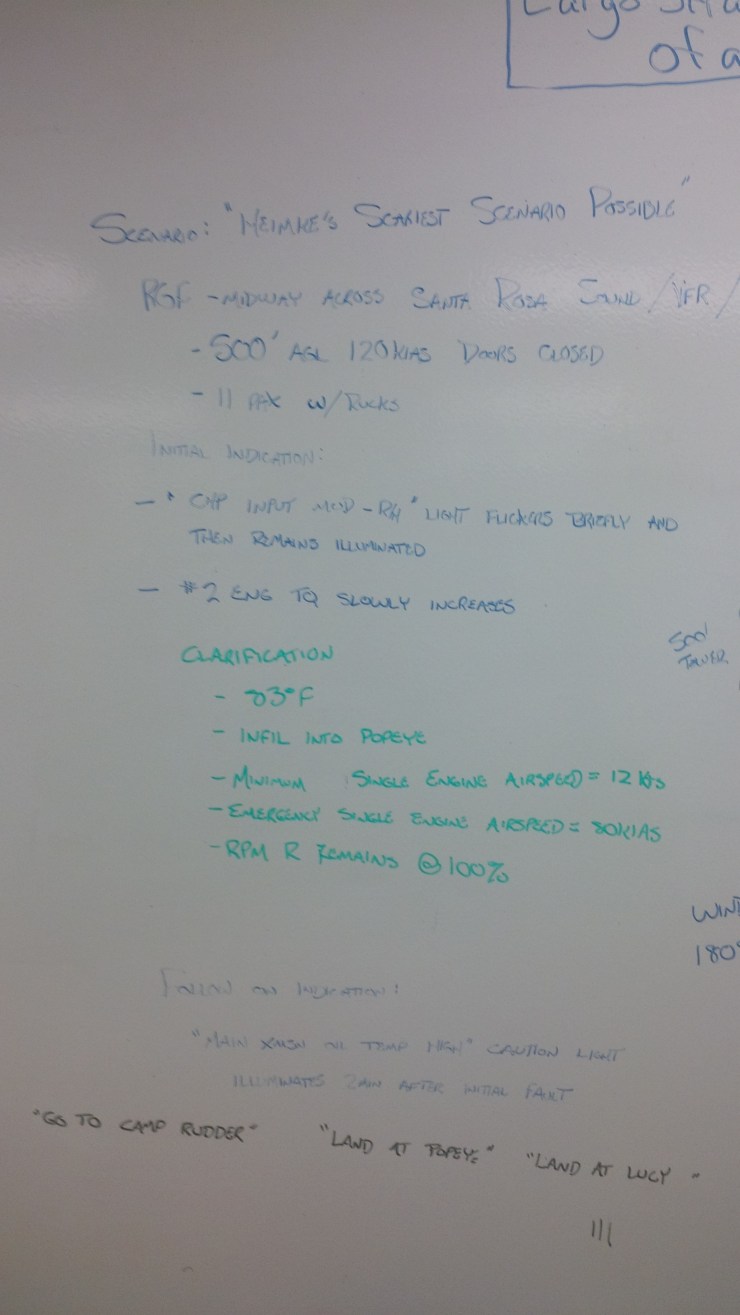
Scenario: “Heimke’s Scariest Scenario Possible”
RGF – midway across Santa Rosa Sound / VFR / 0000 Local/ 15% illum
- 500’ AGL, 120 KIAS, doors closed
- 11 pax w/rucks
Initial indication:
- “CHP INPUT MOD – RG” light flickers briefly and then remains illuminated
- #2 ENG TQ slowly increases
Clarification
83̊ F / Wind 180 @ 4 kts
Infil into Popeye
Minimum single-engine airspeed = 12 kts
Emergency single engine airspeed = 80 KIAS
RPM R remains @ 100%
Follow-on indication:
“MAIN XMSN OIL TEMP HIGH” caution light illuminates 2 min after initial fault
Options:
“Go to Camp Rudder,” “Land at Popeye,” or “Land at Lucy”
The title was drawn from the comment of the first crew chief who saw this simple problem and extrapolated the possible causes and courses of action. To return to Camp Rudder was quickly denounced by all participants as prolonged flight with possible metallic contamination in the main transmission oil system and indications that a critical part of the drivetrain was slowly self-destructing was something that no one could imagine as plausible and advisable. The other two choices were also sinister – one required a 180̊ turn to the north and the mainland of Florida, while the other would place them on an approach to a narrow barrier island and a 90̊ turn to line up on the paved road running in between sand dunes. The “scary” part of the scenario was also one which we as crew chiefs dreaded – the corralling of a full load of sleep-deprived trainees in dubious terrain at night.
[Edit]
I realize I might have lost the audience with both the title and the reference. I provided a more specific explanation in a different post:
For those unfamiliar, the “Kobayashi Maru” was a simulation which presented no path towards victory. Designed as such, there was only one rationale for subjecting potential starship captains to such a decidedly dire situation:
“The purpose is to experience fear. Fear in the face of certain death. To accept that fear, and maintain control of oneself and one’s crew.”
These examples were the dry-erase board solution to idle crew chiefs in an ideal unit – the scheduled and unscheduled maintenance for the aircraft was performed by contractors and the flying was their only major task. The intent was to provide two solid examples as the template and progressively delegate the creation of future scenarios to all crewmembers as time permitted, generating creativity and competition as they delved deeper into the systems, theory, and doctrine of their professions. Computers were only used to clarify locations using Google Maps, hard-copy manuals and checklists were abundant, and – most importantly – consensus was developed as the banter, analysis, and ultimately, confidence in their fellow crewmembers was fostered.
Effective training rarely needs high-end technology and impressive graphics to truly be effective. In some cases, the basic ingredients require a checklist, a dry-erase board, an engaged audience, and a demented imagination.
How does this apply to other organizations?
Technology has, so a certain extent, become our crutch and the solution to “problems” that never stopped us before. Any organization has the potential to benefit from scenario-based training – whether it is to look at the potential fallout from a bad public-relations incident, patent infringement, industrial espionage, sudden shifts in production demands, or a list of other factors which necessitate immediate and deliberate action. Such “thought exercises” not only initiates conversation and discussion about true threats to the organization, but allows those within the exercise to understand and observe talent, creativity, and potential for future development.
Discover more from milsurpwriter
Subscribe to get the latest posts sent to your email.
 milsurpwriter
1 thought on “Kobayashi Maru – Army Style… or… Scenario-Based Training”