Examine the life and military biography of William “Billy” Mitchell (1879-1936). How did Mitchell’s professional military career and experiences inform his views on the possibilities of American air power? What is his legacy to American air power?
They cyclic nature of history provides an interesting look at the theories and warnings espoused by Mitchell in the 1920’s and modern day indicators which suggest that the lessons learned almost a century ago remain unheeded stories from the past. Mitchell’s career in the Army was one of unprecedented upward movement within the ranks – at the age of 18, he was the youngest officer, later to be the youngest captain at the age of 24.[1] It was his appointment to the Army General Staff by the time he was 33 that showed that his rise in the ranks was not merely one of connection, but of sheer ability and talent.[2] It could be suggested that such a rapid rate of advancement proved to be his later undoing regarding a temperament which was charismatic, yet demanding and unapologetic.[3]
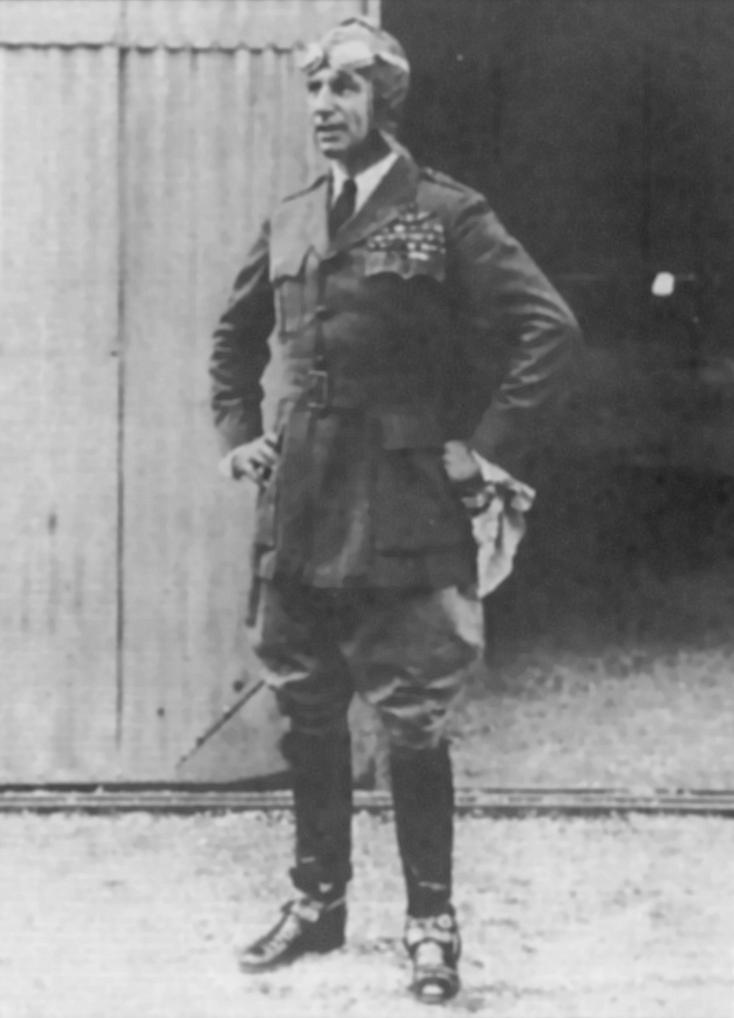
- “Demanding and unapologetic” could also be viewed as “non-regulation.” (Source: wikimedia commons)
Much of Mitchell’s formative experience with airpower originates from his service in the First World War and it was during this time that he began to understand the potential in air power in future battles. With early ideas of large airborne assaults of infantry beyond the front lines and a fundamental concept of what would later become the strategic bombing of enemy industry and infrastructure, Mitchell’s biggest legacy to the future military value of aircraft was his emphasis of the idea that aircraft could defeat warships.[4] Proving this point in 1921 by sinking the captured German battleship, the Ostfriesland, Mitchell’s highly publicized tests drew the irritation of Navy leadership despite the factual evidence he had provided.[5] Court-martialed four years later for insubordination, Mitchell’s trial highlighted both the vulnerability of the aviation assets which provided national defense as well as the bias against him by key members of the court.[6]

Mitchell’s legacy to airpower was proven by the Japanese in 1941. Their attack on Pearl Harbor almost perfectly echoed his prediction from 1923 to the hour and manner of execution,[7] and later use of bombers to exert military force against key cities culminated in the dropping of atomic bombs on Hiroshima and Nagasaki in 1945.[8] Unfortunately, both the words and trial of Mitchell have been relegated to mere academic study, and the cycle continues. Reminiscent of the testimony of Major Spaatz’s commentary lamenting the atrocious state of readiness Army aviation in the 1920’s, current statements regarding present availability of aircraft in the Marine Corps repeat the same story.[9]
“Can you research and discuss with the class whether Billy Mitchell was influenced by any British air theorists from World War I?”
Billy Mitchell was an interesting character in the early days of military aviation, but his spirit and manner in which he went about materializing his ideas was a key detriment to his cause of airpower. In 1917, he became a protégé of British Major General Hugh Trenchard (1873-1956), who was the commander of the Royal Flying Corps in France. Trenchard’s view on airpower was that it was a means to offensively wage war against an enemy’s morale and capacity to fight.[1] Trenchard understood the basic idea of strategic airpower and air supremacy and correlated these aspects as potentially major contributions towards future victories that could be made by aircraft.[2] He also formulated the idea of aerial interdiction – the direct attacking of logistic and communication assets – during the Battle of Loos in 1915.[3]
The major difference between Trenchard and Mitchell was the way in which both addressed those either critical or indifferent towards their views of airpower. Trenchard had described Mitchell’s drive as a “habit of trying to convert opponents by killing them,” whereas Trenchard was a quiet, yet determined, realist who firmly held his ideas secondary to gaining support for them. [4],[5]
[1] Barney Sneiderman, Warriors Seven: Seven American Commanders, Seven Wars, and the Irony of Battle, (Havertown, US: Savas Beatie, 2006), accessed November 3, 2016, ProQuest ebrary, 202.
[2] Sir John Cotesworth Slessor, Air Power and Armies, (Tuscaloosa, US: University Alabama Press, 2010), accessed November 3, 2016, ProQuest ebrary, 71.
[3] Robert F. Grattan, International Library of War Studies: Origins of Air War, The: Development of Military Air Strategy in World War I, (London, US: I.B.Tauris, 2009), accessed November 3, 2016, ProQuest ebrary, 116.
[4] Barney Sneiderman, Warriors Seven: Seven American Commanders, Seven Wars, and the Irony of Battle, 203.
[5] Robert F. Grattan, International Library of War Studies: Origins of Air War, The: Development of Military Air Strategy in World War I, 203.
[1] Barney Sneiderman, Warriors Seven: Seven American Commanders, Seven Wars, and the Irony of Battle, (Havertown, US: Savas Beatie, 2006), accessed November 1, 2016, ProQuest ebrary, 198, 200.
[2] Ibid., 201.
[3] Ibid., 211.
[4] Ibid., 213.
[5] Ibid., 217.
[6] Mulholland, Mitchell. “The Billy Mitchell court-martial of 1925.” Master’s thesis, University of Massachusetts Amherst, 2014, Accessed on November 2, 2016, http://scholarworks.umass.edu/theses/1819, 132.
[7] Barney Sneiderman, Warriors Seven: Seven American Commanders, Seven Wars, and the Irony of Battle, 218.
[8] Ibid., 231.
[9] U.S. Congress, House, Readiness Subcommittee of the House Armed Service Committee on Aviation Readiness and Safety, Statement of Lieutenant General Jon M. Davis, Deputy Commandant for Aviation, 114th Cong, July 6, 2016, accessed November 2, 2016, http://docs.house.gov/meetings/AS/AS03/20160706/105159/HHRG-114-AS03-Wstate-DavisJ-20160706.pdf, 6.
Discover more from milsurpwriter
Subscribe to get the latest posts sent to your email.
 milsurpwriter